
As if Wolves
Choosing Directions

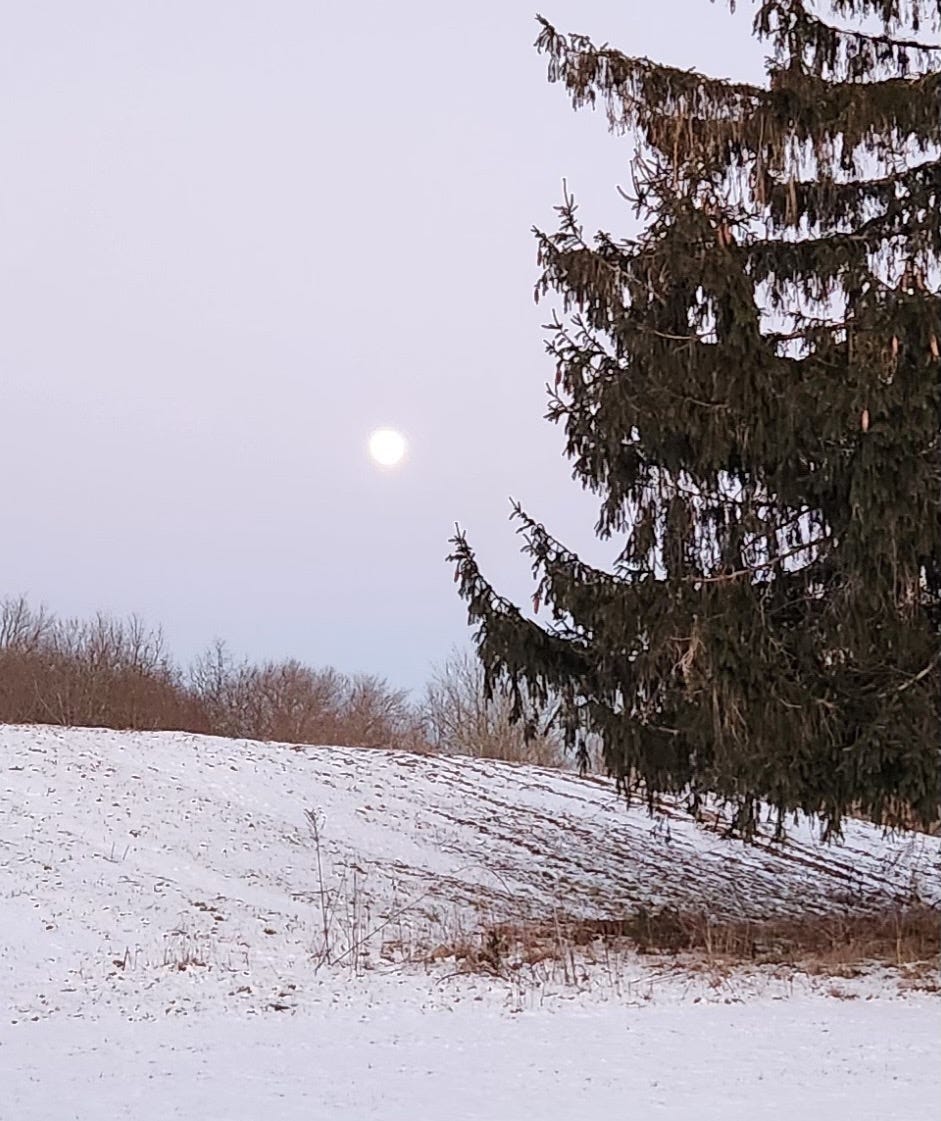
January’s Wolf Moon hung in the morning sky as I parted my bedroom’s blackout curtains and spotted a gray coyote. She stood just beyond the parking lot across the street from my house. A white haze veiled everything. For a second, the coyote stopped. She might have had ice crusted in her paws, she might have sniffed the ducks scattering from ice toward a section of unfrozen pond, she might have listened to something none of us can hear. And in that pause, before she entered the woods, she seemed to choose her direction with care, as a wolf would.

Northeast coyotes have longer legs and smaller ears than western coyotes, a sign that they may have interbred with Eastern Canadian wolves at some point. I imagine this shy dog is a she-wolf. The kind that risks going out alone because she has to, for food or a date. She’d prefer to be with her pack back in the wood. But she is a soldier of duty and priority, and she has her strategies.
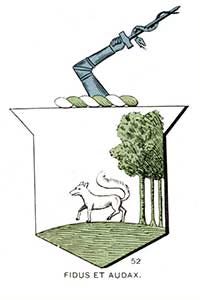
The image on my family crest is of a lone wolf stepping away from oak trees. The story goes that a wolf can confidently, boldly travel alone because she knows she has the luxury to return to her faithful pack, back in the woods. In other words, the lone wolf is only temporarily alone because she has an inner and social compass as her secret weapon.
I’m wondering if I can take the liberty of posing as a wolf, eyes gentle and bold, high on a rock, call-and-response howling with you. I mean, it’s January, and there are months ahead and options of travel and many directions to choose from. Ready to step out of the woods?
What is home for you?
How tired have you become?
How much did you risk—getting lost, isolated, injured, trapped?
What reserves did you pull from the shadows—patience, strength, cleaning your beautiful cinnamon-tipped coat, howling to stay connected to others who were somewhere unseen, normalizing uncertainty with strategic rest and self-compassion, feeding on what you could take and not more?
What part of pack life do you remember most honestly—the young ones you kept warm, the extended family you collaborated with to educate others, the homeland rocks and moss that witnessed history and change, the staying close?


I’m asking because it’s sometimes easy to get nostalgic in the pauses of a journey, when a sense of home may or may not be on the horizon; and it’s even easier to tell stories to ourselves about what pack, or home, we do or don’t or wish to belong to.
Researcher Svetlana Boym, in her 2001 book The Future of Nostalgia, distinguishes two sorts of nostalgia. A “reflective nostalgia” is more focused on the algia: the longing, the hurt of loss, sometimes even calling truth into doubt. Wolves don’t lie when they long to return home. Their memory of scent and blood and river is real. If things go sideways and their separation from the pack is long-term, their pain is also real. We are like wolves this way.


But where humans can differ from wolves is our ability for what Boym calls “restorative nostalgia,” which focuses on the nostos part: the relationship to home itself. This might look like an attempt to reconstruct a lost home or an idealized, patinated past, as if in a romance with fantasy, and we righteously defend the fabrication as tradition or absolute truth. It’s comforting to fall into this fuzzy place instead of touching our feet onto the harsher ground of the present.
I’m thinking of the coyote-wolf at her moment of pause, foot suspended, ears alert. She assesses the quality of light and decides the night is done, the ducks are too far gone, and she has a commitment to keep. Her paw steps down, eyes-on-the-prize of returning to some sense of individual and social compassion, and she treks to the woods.

“She is a soldier of duty and priority” and the shift to your family crest and home were so striking.
I love this Muireann. I especially want to dig in to the questions you pose!